
A trademark search costs somewhere between nothing and $3,000. Skipping one can cost $2,000 or more in a rejected filing, plus months of wasted time. That cost asymmetry alone should settle the question of whether to search. The harder question is which of the many trademark search services to use.
The USPTO processed over 612,000 trademark applications in FY2025, roughly 1,700 new filings every business day. Each one adds to the collision surface for your next brand name. The odds of an exact conflict on a common English word in popular classes like Class 9 (software) or Class 25 (clothing) are higher than most founders expect. For most filers, running a trademark search online before filing is the minimum due diligence.
This trademark search comparison covers four tiers: free government databases, enterprise clearance platforms, mid-market self-service tools, and API-first search. Each tier serves a different use case, budget, and technical requirement. The goal is to help you match your situation to the right tool, not to declare a single winner.
What Trademark Search Services Actually Do
Trademark search services check existing trademark databases for potential conflicts before you file an application. The core function is straightforward: you input a proposed mark, and the service returns registrations and pending applications that might block yours.
But "search" covers a wide range of capability. At the simplest level, a knock-out search checks for exact matches of your proposed name against registered marks. This catches the obvious conflicts. The name you want is already registered in your class, in your jurisdiction. Done, move on.
A comprehensive trademark clearance search goes further: phonetic similarity (does "SIGNA" conflict with "CYGNA"?), visual similarity (logo comparisons), conceptual similarity (marks that mean the same thing in different languages), common-law usage, state registrations, and domain names. A thorough clearance search through a law firm typically runs $1,000 to $3,000 and produces a detailed risk assessment. The stakes of skipping clearance are real and quantifiable.
The market breaks into four tiers:
- Free government tools (USPTO, WIPO, EUIPO) provide direct database access at no cost
- Enterprise clearance platforms (Corsearch, CompuMark) offer full-service search with analyst review
- Mid-market self-service tools (Trademarkia and similar) sit between free and enterprise
- API-first services (Signa and others) provide programmatic access for building search into products and workflows
Each tier trades off coverage, matching sophistication, price, and workflow flexibility. Rising filing volumes make the choice more consequential each year.
Trademark Database Coverage by Number of Offices
Free Government Tools: Good Starting Point, Clear Ceiling
Every major trademark office offers a free search tool. If you are checking a single name in a single country, these are a reasonable first step.
USPTO Trademark Search. The US Patent and Trademark Office retired its legacy TESS system in late 2024 and replaced it with a modernized search interface. The new tool searches active and pending US trademarks. It is free, reasonably fast, and covers the full USPTO register. The limitation: it supports only exact and basic wildcard matching. No phonetic analysis, no fuzzy matching, no similarity scoring. If your proposed name sounds like an existing mark but is spelled differently, the USPTO tool will not flag it.
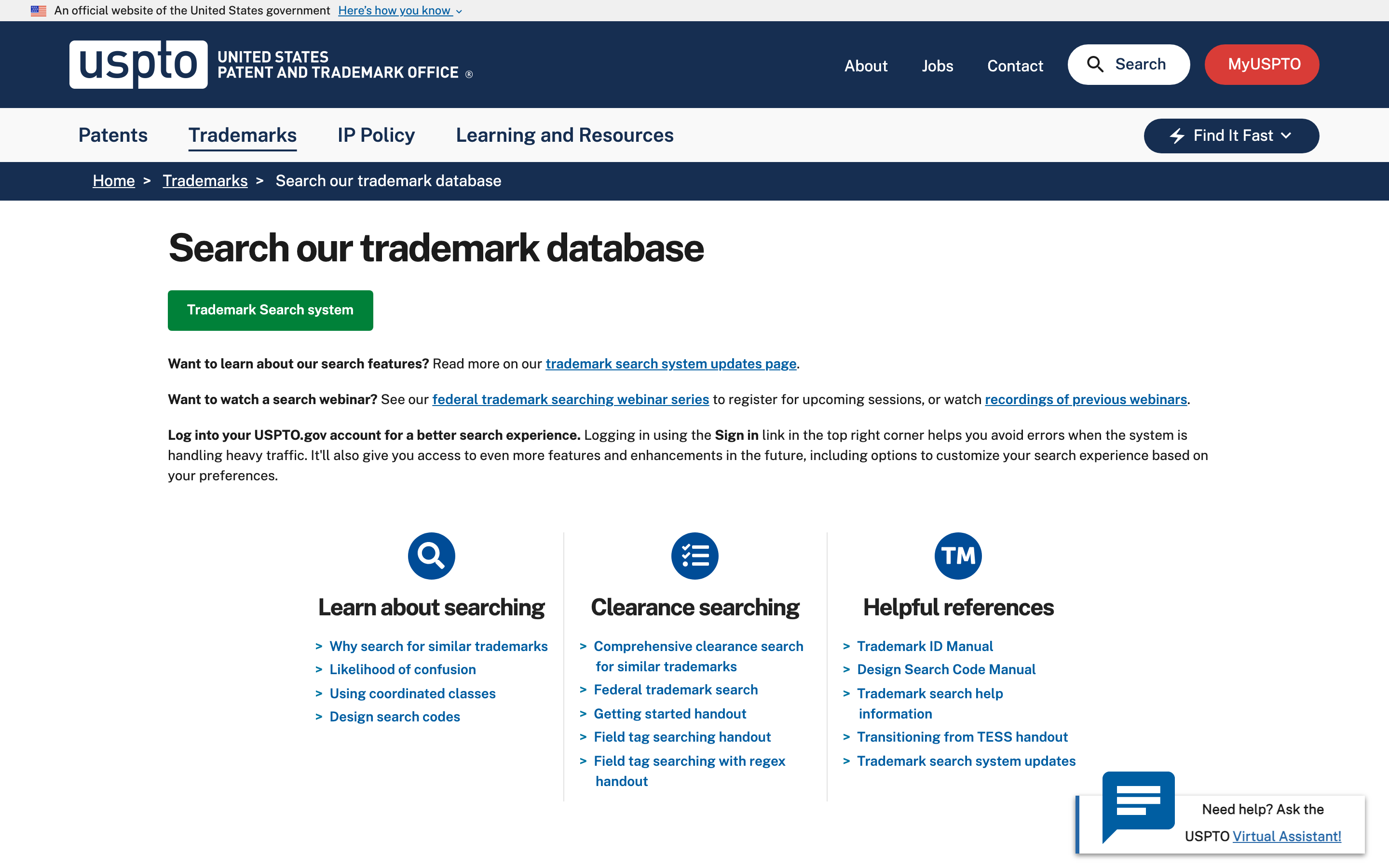
The USPTO's trademark search landing page, which replaced the retired TESS system with a modernized search interface
WIPO Global Brand Database. The World Intellectual Property Organization's search covers over 72 million records from 74 participating offices, making it the broadest free tool available. That 72 million spans marks from most major economies, though coverage varies by office and some data lags by weeks or months. WIPO does offer some fuzzy matching capability, which puts it ahead of the USPTO tool for catching near-misses. For anyone searching outside the US, WIPO is the strongest free starting point.
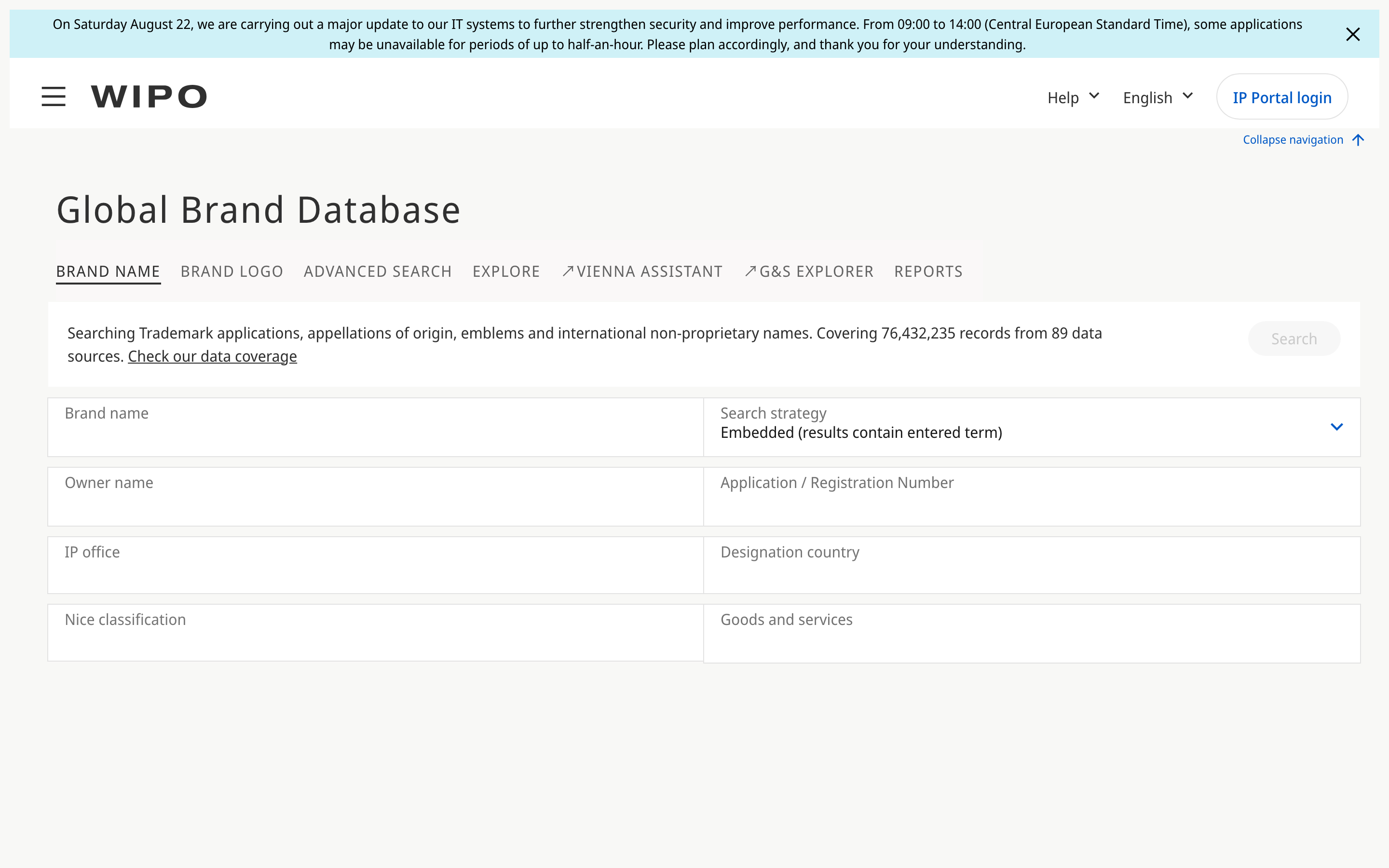
WIPO's Global Brand Database search interface with fields for brand name, owner, IP office, Nice classification, and multiple search strategies
EUIPO eSearch plus and TMview. The European Union Intellectual Property Office provides eSearch plus for EU trademarks and TMview for a broader network of national European registrations. Both are free and useful for European searches, though the interfaces can be slow and search capabilities are basic.
The shared ceiling. All free government tools share the same limitations: no risk scoring, no monitoring for new conflicts after your search, no multi-strategy matching that combines phonetic, visual, and conceptual analysis in a single query. They search one database at a time. They return results but do not help you interpret them. For a quick knock-out check on a single name in one jurisdiction, they work. For anything beyond that, including the phonetic matching that catches the most dangerous near-misses, you need a paid tool.
Enterprise Clearance Platforms: Full-Service, Full Price
At the other end of the spectrum, enterprise platforms offer comprehensive clearance as a managed service.
Corsearch is the market leader in enterprise trademark clearance. After acquiring TrademarkNow (an AI-powered screening tool), Corsearch now covers the full workflow: screening, comprehensive clearance, watching, and enforcement. Its client list includes Fortune 500 IP departments and major law firms. The platform combines automated search with analyst-reviewed reports, which means a human examines the results and flags the highest-risk conflicts.
CompuMark, part of Clarivate's intellectual property division, holds a similar position. CompuMark sits within a broader analytics suite that includes patent and domain data, making it attractive to corporate IP departments managing portfolios that span trademarks, patents, and trade secrets.
What you get at this tier: full clearance reports covering federal, state, and common-law sources. Multi-jurisdiction searches across dozens of offices. Analyst review that interprets the results, not just returns them. Ongoing monitoring that alerts you to new filings that conflict with your existing marks. Integration with watch services for enforcement.
What you give up: speed and accessibility. Enterprise platforms typically require annual contracts ranging from $10,000 to over $100,000 per year depending on search volume and features. Procurement cycles can take weeks. The tools are designed for IP professionals managing large portfolios, not for a developer checking a name before buying a domain. If you file five trademarks a year, the math does not work. If you file fifty or manage a portfolio of hundreds, the per-search cost becomes reasonable and the analyst review genuinely valuable.
Consult a trademark attorney for legal guidance on whether a full clearance report is necessary for your specific filing situation.
Mid-Market and Self-Service Platforms
Between free government databases and enterprise clearance, a growing tier of self-service platforms targets founders, small businesses, and individual filers.
Trademarkia is the most visible player here. It offers a consumer-facing search interface with a freemium model: basic search is free, and Trademarkia bundles trademark filing services for an additional fee. The platform is primarily US-focused and emphasizes ease of use over analytical depth. For a founder checking a single name before filing a US application, Trademarkia provides a more approachable experience than the USPTO's raw search tool.
Other platforms in the $50 to $500 per month range offer more structured search capabilities: batch searching, basic monitoring, multi-class coverage, and exportable results. Some include AI-powered similarity detection, though the quality varies across providers.
This tier fills a real gap. Free tools lack matching sophistication. Enterprise platforms are priced for corporate IP departments. Mid-market tools give individual filers and small teams access to better-than-basic search at a price that matches their stakes. A founder registering one trademark does not need a $50,000 annual contract. They need a tool that catches phonetic and visual similarities, covers their target jurisdictions, and costs less than the filing itself.
The limitation is depth. Most mid-market tools focus on US trademarks, with limited international coverage. Common-law searching (unregistered marks that still have legal protection in the US) is typically absent or minimal. Monitoring, if available, is basic. For a single domestic filing, these tools are often sufficient. For international expansion or contested markets, the coverage gaps matter.
API-First Search: Building Trademark Intelligence into Products
API-first trademark search is a distinct category, not just another tier. The question it answers is different: instead of "how do I search for trademark conflicts?" it answers "how do I build trademark search into my product?"
The use cases are specific. Domain registrars want to flag potential trademark conflicts when a customer registers a new domain. E-commerce platforms need to screen product listings and seller brand names at scale. Legaltech companies build clearance workflows where trademark search is one step in an automated pipeline. Compliance tools need ongoing monitoring across hundreds of marks. None of these use cases work with a GUI you log into manually.
Signa's API covers 147M+ trademark records across 200+ offices, with phonetic, fuzzy, and exact matching available in a single call. That 200-office coverage is notably broader than what most enterprise platforms offer, though the comparison is not apples-to-apples: Signa provides search and data access, while enterprise platforms bundle analyst review and legal interpretation. The API follows pay-per-call pricing, which means a developer can start with a few test searches and scale to thousands without negotiating an annual contract.
For a deeper comparison of programmatic trademark search options, the key differentiators are coverage breadth, matching strategies, response format, and pricing model. The right API depends on what you are building and which jurisdictions matter to your users.
API-first search is not a replacement for the other tiers. A founder filing one trademark does not need an API. A law firm running clearance searches does not need to build a custom integration. But for any product or workflow where trademark data needs to flow programmatically, an API is the only viable architecture.
How to Choose the Right Trademark Search Service
The comparison table below summarizes the key dimensions across all four tiers:
| Dimension | Free Government | Mid-Market | Enterprise | API-First |
|---|---|---|---|---|
| Coverage | Single office (WIPO: 74 offices) | Primarily US, some international | Multi-jurisdiction, 50-100+ offices | Varies (Signa: 200+ offices) |
| Matching | Exact, basic wildcard | Phonetic, some fuzzy | Full: phonetic, visual, conceptual | Phonetic, fuzzy, exact |
| Common-law search | No | Rarely | Yes | No (trademark registers only) |
| Monitoring | No | Basic (some providers) | Yes, with alerts | Via polling or webhooks |
| Analyst review | No | No | Yes | No |
| Pricing | Free | $0-$500/month | $10K-$100K+/year | Pay-per-call |
| API access | No | Rarely | Limited | Core feature |
| Best for | Quick knock-out checks | Individual filers, founders | Corporate IP, law firms | Developers, platforms |
Service Tier Comparison Across Key Dimensions
Beyond the table, here is how to match your specific situation to the right tier:
One-time founder filing a single mark. Start with the USPTO search tool (or WIPO for international) for a free knock-out check. If nothing obvious appears, consider a mid-market tool for phonetic matching. If the name is in a crowded class or you have significant brand investment at stake, pay for a comprehensive clearance through a law firm. Total cost: $0 to $3,000 depending on risk tolerance.
Growing startup with multiple marks. A mid-market tool covers the basics for ongoing searches. As you expand internationally, the coverage gaps will push you toward enterprise platforms or API-based solutions that cover more offices. Consider your search strategy fundamentals before committing to a tool.
Law firm or corporate IP department. Enterprise clearance platforms justify their cost at scale. If you run dozens or hundreds of clearance searches per year, the per-search economics improve, and analyst review catches risks that automated tools miss. The annual contract model aligns with how IP departments budget.
Developer or platform company. If trademark search is a feature in your product, not a one-time task, an API is the only architecture that scales. Manual tools do not integrate into automated workflows. Evaluate APIs on coverage, matching quality, response time, and documentation.
Four factors matter most, in order:
-
Coverage breadth. How many offices does the service search? If you operate only in the US, USPTO coverage is sufficient. If you sell internationally, you need multi-office search. The gap between 1 office and 200 offices is the difference between checking one country and checking everywhere your brand might conflict.
-
Matching quality. Exact matching catches identical names. Phonetic matching catches similar-sounding names. Fuzzy matching catches misspellings and variations. Visual and conceptual matching catch logo and meaning-based conflicts. The more matching strategies a service supports, the fewer dangerous conflicts it will miss.
-
Price relative to stakes. A $0 search is the right choice when you are brainstorming names. A $3,000 clearance is the right choice when you are about to invest six figures in a brand launch. Match the cost of the search to the cost of getting it wrong.
-
Workflow fit. Will you search once, monthly, or continuously? Will a human run the search, or does it need to happen programmatically? One-time searches work in any GUI. Continuous monitoring requires a platform with alerts. Product integration requires an API.
One gap that spans all tiers: common-law rights. In the US, trademark rights arise from use, not just registration. A business can have enforceable trademark rights without ever filing with the USPTO. Most search services, whether free or paid, search only official trademark registers. Common-law conflicts (unregistered business names, state registrations, domain names with brand use) require additional research that falls outside what most tools cover. For high-stakes filings, a trademark attorney can supplement a database search with common-law investigation. Consult a trademark attorney for guidance on whether common-law searching is necessary for your situation.
Finding the Right Fit
The best trademark search service depends on three variables: how often you search, how many jurisdictions you care about, and whether search is a task you perform or infrastructure you build into a product.
Free tools handle the knock-out check. Mid-market platforms add matching sophistication for individual filers. Enterprise platforms deliver full-service clearance for large portfolios. API-first services provide the programmatic access that developers and platforms need.
No single tier is universally best. A founder checking one name and a registrar screening thousands of domains per day have fundamentally different requirements. Match the service to the use case, not the other way around.
If you are building trademark search into your product or workflow, explore Signa's API, free to start, at signa.so.